
What are Veneers?
Dental veneers are made using resin or porcelain. Most people pick porcelain veneers instead of resin ones since they have a greater ability to resist stains than resin. Moreover, these veneers have a low risk of getting discolored. It is important to maintain good oral hygiene. It is always good to choose the low-maintenance option as with everything else.

How do Veneers Work to Fix a Tooth?
Veneers are a thin layer of porcelain (ceramic material) or composite (resin material) that we bond to your tooth’s enamel in order to change the shape, size, look and or/feel of the tooth and your smile. In fact, we once had a patient refer to veneers as “press-on nails for teeth” – and in concept she wasn’t wrong.
Do Veneers work with Dental Implants?
No. A dental implant is a tooth-shaped titanium prosthesis that is placed into an area of your mouth where you do not have an existing tooth. A veneers is a treatment that is used only for exsting natural teeth.
Can Anyone Get Dental Veneers?
No. When it comes to fixing your smile with veneers (or crowns – which is the other alternative) – there are specific reasons where one approach would be preferred over the other.
In general, you are not a candidate if you have an active infection in your mouth, poor oral hygiene, and/or cavities. These conditions must be addresses before any cosmetic dental treatment is started in order to make sure we have a healthy starting point and can lay the best groundwork for success. For example, you don’t want to place veneers only to later find out that one of the teeth next to it has a cavity, and that the colors won’t match. Dr. Nagrani will perform a comprehensvie examination of your teeth and gums to make sure that you mouth is healthy and free of gum disease, and make sure that your treatment is appopriate.
When it comes to veneers vs. crowns, people with the following conditions will likely be better candidates for crowns:
- Extreme tooth crowding
- Underbite or crossbite
- A habit of grinding teeth or clenching jaws
- Major damage to your tooth structure
Veneers vs. Crowns
From the perspective of cosmetic dentistry, veneers and crowns work to improve the appearance of your teeth. The major differences are:
- What condition(s) are we trying to fix
- The type of material
- The amount of tooth structure kept or removed
- The longevity of the restoration
- The cost of treatment
Veneers are thin pieces of ceramic or composite that fit directly on top of the enamel of your teeth and are designed to fix smaller, more localized cosmetic conditons such as small chips, rotations, or discolorations.
Crowns (or caps) are ceramic restorations that go over the tooth (like a glove over your handO and indicated where the teeth have a history of large fillings or previous crowns, large chips, or in patiens with a deep or strong bite. Crowns are thicker than veneers are thus desgined to absorb more force from the bite vs. veneers.
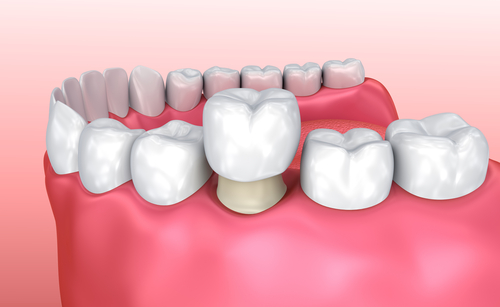
Veneers and crowns can last many years, and the longevity of either restoration has more to do wtih oral hygiene and your bite vs. the veneer or crown itself. That is, if you keep your mouth clean and your gums healthy, crowns and/or veneers will last a long time.
Advantages vs. Disadvantages of Veneers
Veneers are thin, and the advantage of this property is that very little drilling of your natural teeth is needed when compared to crowns. But because they are thin, veneers can tend to fracture at a higher rate vs. crowns. It’s also important to rember that because veeners are so thin, that crowns may be indicated when a tooth has a very deep or dark discoloration that needs more material on top of it to block tihs out.
Veneers typically last for many years, and don’t require any special home care other than normal brushing and flossing.
When you have cracked or chipped teeth, you can feel pain, especially when breathing, speaking, brushing your teeth, drinking, or eating. One way of solving these problems and improving your smlie at the same time is with dental veneers.
How Many Veneers Do I Need?
A common misconception is that a person has to have veneers placed on every tooth – and this is not true. You can have a veneers on only a few teeth, or only one tooth in some cases.
The number of veneers depends upon on the number of teeth in a patient’s mouth that need to be corrected or covered by the veneer. An experienced dentist like Dr. Nagrani can get you veneers that match your natural teeth to give you a perfect look.
Different Types of Veneers
There are three general types of veneers that we use in dentistry
Porcelain Veneers
Porcelain veneers are thin sheets of ceramic that we use to improve the esthetics of your teeth. They are cemented on top of your teeth and can last many years. Porcelain veneers require that we take a mold of your teeth so the custom veneers can be fabricated to precicely match the colors and shapres of your teeth.
Composite Veneers
Composite veneers are veneers that are made out of the same material that we use when we do white fillings (bondings). They often require less preparation vs. porcelain veneers but can chip at a higher rate and can discolor more quickly over time vs. porcelain veneers.
No-Prep Veneers
No-prep veneers are veneers that require a very minimal amount of tooth preparation but tend to have more long-term issues vs. porcelain or composite veneers, and limited in the types of cosmetic problems that they can fix.
Treatment Details
What is the dental procedure for veneers?
Before placement
While there is some variation, generally speaking we will create models of your teeth, and plan out how the veneers are going to look before starting treatment. The teeth are prepared and information is sent to the dental laboratory so they can fabricate the veneers. You will wear temporary veneers while the final veneers are being made in the lab.
At placement
At the placement visit, the veneers are checked for quality and for fit, and are adjusted so that they align properly with your teeth. We make sure that you can floss in-between the veneers and that they fit well near the gumline (veneers that are too close to the gum line can cause inflammation and redness – and we do not want that!). The veneers are cemeneted into your mouth, and they are yours to keep!
Risks and Benefits of Treatment with Veneers
Benefits of Dental Veneers
Veneers are rapid way to fix the shape, size, and/or positioning and color of your teeth, and will last many, many years.
Veneers are less invasive than dental crowns and require less drilling and thus we preserve more tooth struture. Treatment with veneers can be an alternative to longer-term orthodontic solutions, where you get the benefit of straighening your teeth and the option of changing the shape and color.
Risks of Dental Veneers
Just like natural teeth, veneers can crack and chip. You are free to eat anything you want. However, there are certain things you must avoid to prevent your dental veneers from getting ruined. For example, while you probably could bite into a hard, toasted bagel, it makes sense to not bite down with that type of force with your veneers. Similarly, if you have habits such as chewing on ice, it can lead to premature failure or your veneers (or any restoration) beacause of the forces applied.
Veneers can also stain, but it’s much more likely for composite veneers to stain vs. porcelain veneers. And someone who drinks coffee and red wine is likely to see more staining than someone who does not drink these types of beverages.
Long Term Outlook and Care of Your Veneers
With proper care and maintenance, veneers can 10-20 years.
How Long Do Veneers Last?
When you take good care of your teeth (and your veneers) you’ll enjoy the benefits or your new simle for many years. To get themost benefit from your veneers and ensure that they stay healthy for a long period, we recommend that our patients:
- Maintain proper oral hygiene
- Come in for regular checkups and cleanings
- Treat your veneers just like your real teeth
- Ensure that your gums are always healthy
- Avoid chewing or biting on very hard foods directly with your veneers
Cost of Veneers
Unlike other restorations such as fillings, dental veneers are considerd to be a cosmetic procedure, regardless of the reason that one might have veneers placed. Practically speaking, this means that most insurance companies will not cover the cost of veneers, and each veneer can cost between $1000-$2000.
The Big Picture
Veneers are a great way to quickly improve your smile by fixing the look, shape, position, and or/color of your teeth
Veneers are indicated for patients who have good oral health and oral hygiene.
Veneers are not covered by dental insurance but can be seen as an investment in your smile that can last decades.
Why You Should Choose Jack Nagrani as your Dentist
If you are in Hanford, CA and want to see if having veneers is the correct approach for your mouth and for your smile, get in touch with us. Dr. Jack Nagrani is an experienced cosmetic dentist and will walk you through the journey of seeing if veneers are the correct treatment choice for you, and ensure that you end up with a beautiful and natural-looking smile – regardless of the cosmetic approach we take.
Contact us today to book an appointment so you can see what Dr. Nagrani and the team can do for you.